Wednesday, May 25, 2011

From fame to notoriety

Major-Gen Pushpendra Singh (retd)


Capt Sir James Abbott established the cantonment town of Abbottabad


SOON after the British defeated the Sikhs at Sobraon, Capt Sir James Abbott, KCB, an officer of the Bengal Artillery, was appointed the first Deputy Commissioner of Hazara district bordering the Pakhtun lands. He was immediately faced with lawless gangs of soldiers of the Sikh Army, who harried the British and ravaged the land to make a living.


Meanwhile, the Pashtun tribes astride the Hindukush, disciplined and suppressed for decades by the Sikh kingdom, were only too happy to at last resume their plunder of Punjab. Captain Abbott had been greatly impressed with the valour of the Sikh artillerymen during the Anglo-Sikh wars. These gallant soldiers epitomised the finest traditions of the gunners and established the norm of defending their cannon to the very last man — at great cost to the British.


Sir James decided to kill two birds with one stone. Persuading his boss Sir Henry Lawrence to make an exception to the British dictum, ‘no natives in the Gun-Park’, he raised the Hazara Mountain Battery in 1848. Later, this valiant and distinguished officer rose to the top as a General. In 1851 the Punjab Irregular Frontier Force or PIFFERS was also formed there and the cantonment town, which Sir James established, became known as Abbottabad of erstwhile fame and recent notoriety.


The Hazara Mountain Battery was almost continuously in action with various mule-pack guns, which proved to be the undoing of the Pathans. The daring and skill of the Mountain Gunners inspired the immortal lines of ‘Screw Guns’ by Kipling. Thus was born the legend of the ‘big men with their little guns.’ Initially, the Battery helped defend Hazara district and later enabled Sir Sam Browne to take the Khyber. The unit was at the relief of Kabul, remaining there until it joined Lord Roberts on his march on Kandahar.


On Independence, the Hazara Mountain Battery was en route from Nowshera in Pakistan to India and was immediately pressed into the first Kashmir war, 1948. One troop was airlifted into besieged Poonch by the legendary Wing Commander Mehar Singh, even as his aircraft was hit on the landing strip and rendered AOG (aircraft on ground) by machine-gun fire. The Hazaras were instrumental in turning the tide and saving Poonch.


The Troop Commander, late Colonel Gopal Singh, was decorated with the Vir Chakra for his gallantry. It is perhaps the only Battery in our artillery to win two Vir Chakras.


Such is the other legacy of Abbottabad.


Source Link: http://www.tribuneindia.com

Wednesday, October 22, 2008

Practice Camp Kurram Garhi, near Bannu...

Monday, October 20, 2008

The Second Anglo-Afghan War

Hello Rohit, many thanks for your email.

Here's a summary from my research:

No. 4 Hazara Mountain Battery was part of the 1st Division Peshawar Valley Field Force in the Afghan war, taking part on the attack on Ali Masjid as part of the flanking column under General Macpherson. I don't believe any shots were fired by the battery in this action. They spent much of the first campaign at and around Jalalabad. In the the gap between hostilities in 1879 they were stationed at Landi Kotal. In the second campaign they were again at Jalalabad (seeing action there) though 4 guns were sent with General Gough to aid Roberts at Kabul, reaching there on 24 Dec 1879 after the attack on Sherpur had been repulsed. Those guns were sent with General Ross, in April 1880, to hook up with General Stewart's Kandahar-Ghazni force (seeing action at Zaidabad). The battery left Kabul on 4 Aug 1880, returning to India.

I hope that is of interest, and sorry it's a little brief. I really enjoyed your excellent blog - do keep it up.

Thanks again, and best regards -
Garen

Garen Ewing
The Second Anglo-Afghan War resource at:
http://www.angloafghanwar.info

Mountain Battery Lines

Photograph of Mountain Battery Lines in Abbottabad, now in Pakistan, from the Macnabb Collection, taken by an unknown photographer in the 1860s. Abbottabad was founded in 1853 by Major James Abbott, the first Deputy Commissioner of the Hazara District. This district ran from the Himalayas in the north towards Rawalpindi in the south. Abbottabad was a cantonment, or permanent Army base, for the region. The garrison there consisted of four Gurkha battalions and four mountain batteries; this is a view of some of the mountain battery buildings.

Friday, October 17, 2008

"Echo Guns"
Bring it into Action!
Spin those trails around!
There's grunts up the sharp end,
screaming out for rounds.


Set the elevation!
Traverse on for line!
Strattons just a'loaded,
there's still a little time.

Me, I'm on the left side!
Bob, he's on the right!
Dingus yells "You ready Subs?"
the methods "Battery Right".


When the mission's over!
"Detachments to the Rear!"
"A little slow that time Subs",
John whispers in my ear.


1890 - Gunner - 4th (Hazara) Mountain Artillery Battery


The Punjab was annexed at the end of the second Sikh war in 1849 and the Punjab Irregular Frontier Force (the "Piffers") formed to maintain order amongst the Pathan hillmen. The 4th (Hazara) Mountain Artillery Battery was established in 1848 and added to the original "Piffers" in 1856. The "Piffers" were raised in khaki, and many wore nothing else although full dress for mountain batteries was supposed to be a blue with red facings similar to the RA. Noteworthy are the loose Indian slippers which suited the hill-work, and the artillery sword. Sikh Gunners became associated with the finest traditions of Gunnery during the "Sikh wars". To great British cost Sikh batteries established their norm of serving the guns to the very last man. After many attempts to solve the problem of providing effective artillery support in challenging hill country, the solution was found in the pack-gun, carried on mules. The newly forming mountain batteries made the most of the high standards by deliberately enlisting a large proportion of Sikhs. So began the legend of these "big men with little guns". Their reputation quickly spread far beyond the Northwest frontier of India and contributed to mountain artillery becoming a separate branch, with its own depot, traditions, a unique and strong esprit de corps, and an ethos that continues to demand respect The 4th was one of 4 field and 2 mountain batteries. The "Piffers" standing was so high that none of them were transferred when all other Indian artillery was moved to the RA after the "Mutiny". Later two of the field batteries were disbanded and the remaining two converted to mountain Artillery. In 1860 two Bombay field batteries became mountain batteries, and four more were subsequently raised. Like all mountain batteries the 4th was almost continuously in action, serving several of the pack-guns, including the "screw-gun" immortalised by Kipling. Initially it was raised from Hazara gunners to help defend the Hazara District of the North-West Frontier. Later it helped Sir Sam Browne take the Khyber. It was at the relief of Kabul, remaining there until it joined Roberts on his march on Kandahar. 1885-87 found it in Burma, 1895 on the Indian Frontier as part of the Chitral Relief Force. WWI saw it deployed to East Africa in 1917, where it remained until Armistice. Afterwards it saw service in the Third Afghan War, the Red Shirt and Afridi Disturbances, the Mohmand Campaign, and operated against the Fakir of Ipi in Waziristan. It was deployed to Singapore at the opening of WWII in 1939, where, for the first time in its remarkable heritage, it was lost because of the capitulation. One of its most famous achievements occurred in 1891 when it moved out from Bannu to cross the Himalayas. Operating at altitudes between 11,500 and 13,000 feet, the battery marched 540 miles - successfully fighting the entire distance. Inexplicably not a single member has been recognised with a VC. Understandably Indian Artillery dates its origins to the mountain batteries and takes its "Raising Day" as 28 September 1827. This is the formation date of 4th's sister, 5 (Bombay) Mountain Battery.

The Hazara Legacy

The Hazarians won seven battle-honours as well as two VrCs in the independent era. A record from its war diary during the Anglo-Afghan war (19th-century end) encapsulates the legend:

“General Williams, recently arrived in India, didn’t have too great an opinion of the country. He remarked, ‘there are only three things worth seeing here – the Taj at Agra, General Gough leading a Cavalry Brigade and the Hazara Mountain Battery, in action on a hillside.”


Artillery Guns of the 4th Hazara Mountain Battery being loaded onto Dakota VP903. These guns were landed at Punch to provide support to the Isolated army Garrison there.

At independence, the Hazara Battery celebrated its centenary in the Rajauri Sector during 1948 J&K war. One troop was airlifted into besieged Poonch. The dare-devil Wing-Commander Mehar Singh, disregarding hostile machine-gun fire from the surrounding heights, landed his Dakota on the Poonch airstrip. The dismantled guns were deplaned in minutes and brought into action at the airstrip. Before nightfall, the machine-guns had been destroyed and Indian troops had secured the vital air-link for the beleaguered garrison. However, Mehar Singh’s Dakota had been hit and still remains on the airstrip - testimony to the indomitable flyer’s gallantry. Hazara’s Troop Commander, Capt (later Col) Gopal Singh was decorated with VrC.

Wednesday, October 15, 2008

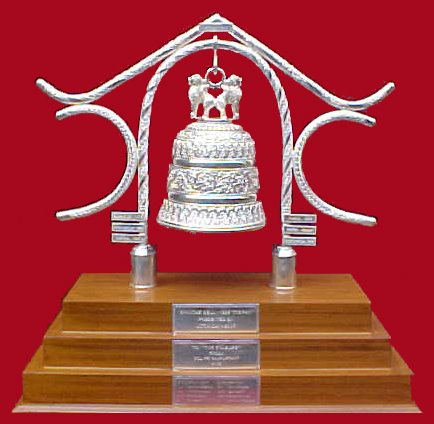
Silver Replica of "Chinthe Bell"


The Chinthe Bell was given by the Head Priest to the Hazarians during the Burmese War 1885-1891 in appreciation of the protection given by them to a Pagoda.

The Chinthe Bell has since then been with the Battery and 56 Field Regiment (JITRA) as a good luck charm. The original bell finds it place of prominence outside The Commanding Officer's office.

This Silver Replica was introduced in 2006. Names of all the Officers serving in the Regiment at that time have been put on the Silver plates on the base.

The Old Granny


The Granny


Gun and carriage dismantled were carried by five mules. Two mules each carried a third of the piece, a third the carriage, a fourth the wheels, and the fifth the rest, ie the axletree, elevating gear, rammer and other stores.

The Granny as it was popularly known as was one of the Mules. Once its commissioned life was complete it was to be "de-commissioned", however the Officers were quite fond of her. It was kept alive on the expenses paid by the officers. On its natural death, one of the hoof's was cured and preserved as a Pen Stand.
The Granny's Hoof still exists in the unit in the Commanding Officer's Office.

Sunday, October 12, 2008

Commemorative Stamp


Gunner and Howitzer from Mountain Battery have been depicted in the stamp commemorating the Golden Jubilee of the Regiment of Artillery.

4 Hazara Photogallery


Copyright Capt Rohit Saxena, 56 Field Regiment(JITRA). All rights reserved

Screw Guns - Rudyard Kipling

Smokin' my pipe on the mountings, sniffin' the mornin'-cool,
I walks in my old brown gaiters along o' my old brown mule,
With seventy gunners be'ind me, an' never a beggar forgets
It's only the pick of the Army that handles the dear little pets - 'Tss! 'Tss!

For you all love the screw-guns - the screw-guns they all love you!
So when they call round with a few guns, o' course you will know what to do - hoo! hoo!
Jest send in your Chief an' surrender - it's worse if you fights or you runs:
You can go where you please, you can skid up the trees, but you don't get away from the guns!

They sends us along where the roads are, but mostly we goes where they ain't:
We'd climb up the side of a sign-board an' trust to the stick o' the paint:
We've chivied the Naga an' Looshai, we've give the Afreedeeman fits,
For we fancies ourselves at two thousand, we guns that are built in two bits - 'Tss! 'Tss!

For you all love the screw-guns...

If a man doesn't work, why, we drills 'im an' teaches 'im 'ow to behave;
If a beggar can't march, why, we kills 'im an' rattles 'im into 'is grave.
You've got to stand up to our business an' spring without snatchin' or fuss.
D'you say that you sweat with the field-guns? By God, you must lather with us -'Tss! 'Tss!

For you all love the screw-guns...

The eagles is screamin' around us, the river's a-moanin' below,
We're clear o' the pine an' the oak-scrub, we're out on the rocks an' the snow,
An' the wind is as thin as a whip-lash what carries away to the plains
The rattle an' stamp 'o the lead-mules - the jinglety jink o' the chains -'Tss! 'Tss!

For you all love the screw-guns...

There's a wheel on the Horns o' the Mornin', an' a wheel on the edge o' the Pit,
An' a drop into nothin' beneath you as straight as a beggar can spit:
With the sweat runnin' out o' your shirt-sleeves, an' the sun off the snow in your face,
An' 'arf o' the men on the drag-ropes to hold the old gun in 'er place -'Tss! 'Tss!

For you all love the screw-guns...

Smokin' my pipe on the mountings, sniffin' the mornin'-cool,
I climbs in my old brown gaiters along o' my old brown mule.
The monkey can say what our road was - the wild-goat 'e knows where we passed.
Stand easy, you long-eared old darlin's! Out drag-ropes! With shrapnel! Hold fast - 'Tss! 'Tss!

For you all love the screw-guns - the screw-guns they all love you!
So when we take tea with a few guns, o' course you will know what to do -hoo! hoo!
Jest send in your Chief an' surrender - it's worse if you fights or you runs:
You may hide in the caves, they'll be only your graves, but you can't get away from the guns!

Quick Recap


The 4 Mountain Battery is also called Hazara battery as it was raised as the Hazara Mountain train on May 18, 1848 in Hazara district (now in Pakistan) by Maj (later General) Sir James Abbot as part of the East India Forces. During this time, the need for mountain battery was felt to keep the trade routes to Central Asia free from raids by tribesmen. Created out of the artillery of Maharaja Ranjit Singh, the 4 Mountain Battery saw active action and went on to become the most decorated mountain battery in the world.
The gallant 4 Mountain Battery has a glorious 153 years old tradition of mountain warfare. The Battery persists in calling itself a ‘Mountain Battery’ even though it functions in the plains and the artillery regiment of which it is a part and is called ‘Field Regiment’. During the early 80s when the equipment used by both mountain and field regiments began to be similar, it was decided to do away with title ‘mountain’ in artillery regiments and to call them all field regiments. But the Hazarians refused to accept this.

A train of mules transporting parts of old screw guns over valleys and hills was familiar sight in the frontier passes of the Hindu Kush mountains at Bannu, Gilgit, Nomal or Kabul during the 19th and early 20th centuries. Hazarians were then known to claim that their guns could be taken wherever an infantry man could go with his rifles, without using his hands and feet.

During the Afghan War Gen Williams who had come from England, declared that there were only three things worth seeing in India, namely the Taj at Agra, the way General Jough handled Cavalry Brigade and the Hazara Mountain Battery.

The honour title of Jitra was the reward given to 4 (Hazara) Mountain Battery (Frontier Force) for its outstanding performance in Malaya in 1941 (Second World War) and was taken over by 56 Composite Regiment (Pack). The Regiment is now a Field regiment as in 1967 and the mules had ceased to be used and this had seen the end of the days of Mule Pack Artillery.
Blog Copyright - Capt Rohit Saxena. All rights reserved.